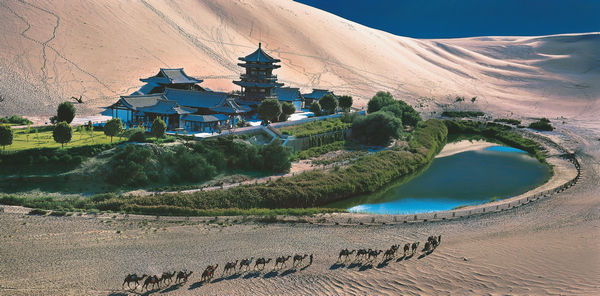
Silk Roads: the Routes Network of Chang'an-Tianshan Corridor
Introduction
The Silk Roads: the Routes Network of Chang'an-Tianshan Corridor, an essential segment of the vast Silk Roads network, encompasses a distance of approximately 5,000 kilometers. It extends from Luoyang and Chang'an, central capitals during China's Han (206 BC-AD 220) and Tang (618-907) dynasties, reaching the Zhetysu region of Central Asia. Established between the 2nd century BC and the 1st century AD, these routes remained vital until the 16th century, underpinning a system of exchanges that connected the ancient societies of Asia, South Asia, Central Asia, Western Asia, and the Near East.
This corridor, recognized as a UNESCO World Heritage Site in 2014, consists of 33 components. These include capital cities, palace complexes of various empires and Khan Kingdoms, trading settlements, Buddhist cave temples, ancient paths, posthouses, passes, beacon towers, sections of The Great Wall, fortifications, tombs, and religious buildings. The corridor served as a major artery for the transmission of raw materials, luxury goods like silk, and ideas, creating a wide-ranging interchange among civilizations that spurred the development of the world's great cultures.
The corridor's vastness, duration of use, and the diversity of heritage remains reflect the extensive cultural interactions within various regions, especially between nomadic steppe cultures and settled agrarian and oasis civilizations on the Eurasian continent. Such interactions are evident in architecture, city planning, religions, urban culture, merchandise trade, and interethnic relations along the routes. The Silk Roads: the Routes Network of Chang'an-Tianshan Corridor thus exemplifies the broadest and most enduring exchange among civilizations and cultures.
Historical Background
The main purpose of the Silk Roads was to transfer raw materials, foodstuffs, and luxury items across vast distances, despite the challenging geographical conditions that varied from 154 meters below sea level to 7,400 meters above sea level. The routes traversed significant natural barriers such as great rivers, deserts, and snow-capped mountains. The extreme climate along the corridor ranged from drought to semi-humid conditions, impacting trade activities that relied on pack animals and river craft for transportation. Notably, China had a monopoly on silk, which it supplied to Central Asia, South Asia, West Asia, and the Mediterranean world. The exchange of goods was complemented by the sharing of religious beliefs, scientific knowledge, technological innovations, cultural practices, and the arts, fostering a dynamic interaction among various cultural regions and civilizations.
Geographical Scope
Chang'an Region
Chang'an, known today as Xi'an, was the starting point of the Silk Roads corridor and served as a central capital during the Han and Tang dynasties. The region was instrumental in driving the Silk Roads trade, providing a gateway for the movement of goods and cultural exchanges between the East and the West. The Loess Plateau at Chang'an marks the beginning of the Tianshan corridor, with routes extending westwards through the Hosi Corridor across the Qin and Qilian Mountains to the Yumen Pass of Dunhuang, facilitating connectivity with Central Asia.
Tianshan Corridor
The Tianshan Corridor stretches from the Loess Plateau at Chang'an to the Ili, Chuy, and Talas valleys in the Zhetysu Region of Central Asia. This corridor was critical in connecting two major power centers along the Silk Roads, fostering interaction between nomadic and agrarian/oasis/pastoral civilizations on the Eurasian continent. The diversity of geographical environments along the corridor, including alpine lakes, deserts, and temperate forests, contributed to the extensive interaction within various cultural regions, showcasing the corridor's significance in cultural and trade exchanges.
Cultural Significance
The Silk Roads corridor was a melting pot of cultural influences, marked by its extensive interaction with multiple cultural regions. The routes facilitated exchanges in architecture, city planning, religions and beliefs, urban culture, merchandise trade, and interethnic relations. The integration of diverse cultures and civilizations along the corridor is reflected in the rich heritage remains and dynamic interlinks between various societies. The Silk Roads created the broadest and most enduring interchange among civilizations and cultures, as exemplified by the Tianshan corridor, which witnessed the confluence of nomadic steppe and settled agrarian/oasis/pastoral civilizations.
Archaeological Findings
Archaeological discoveries along the Silk Roads have provided invaluable insights into the social development and cultural exchanges that took place over centuries. Recent excavations have uncovered monumental cities, tombs, temples, and other sites that reflect the glory of the Silk Road. In the Xinjiang Uygur autonomous region, findings such as the Beiting ruins, Gaochang, and Jiaohe city ruins illustrate the region's historical importance as a key point on the Silk Road. These sites have been included in the UNESCO World Heritage List as part of the Silk Roads: the Routes Network of Chang'an-Tianshan Corridor. Archaeologists have uncovered evidence of diverse religious practices, including Nestorian Christianity, Buddhism, and Taoism, as well as artifacts that highlight the region's role in facilitating cultural exchanges between the East and West.
Cultural Heritage and Promotion
The cultural heritage of the Silk Roads corridor is recognized for its significant contribution to global history and cultural exchanges. Efforts to promote and preserve this heritage have been supported by international collaborations and initiatives. The UNESCO Silk Roads Programme, along with the China National Silk Museum and other institutions, has organized expeditions and webinars to commemorate the Silk Roads' historical significance. These initiatives aim to strengthen international cooperation and promote a deeper understanding of the Silk Roads' impact on world history. Digital archives and scholarly exchanges continue to provide valuable resources for researchers and the public, ensuring the Silk Roads' legacy is preserved for future generations.








